 Extrafinance
 connects lending pools to leveraged farming vaults with borrowing limits
Extrafinance combines asset lending with leveraged yield farming, where borrowed liquidity expands a farming position. Lenders receive pool shares, while farmers manage liquidity positions and debt. Pool utilization influences lending rates and withdrawal liquidity. Each farming vault also has borrowing limits, so available deposits don't automatically mean borrowing capacity.
Key takeaway: A farm can exhaust its borrowing credit even when its lending pool still holds unborrowed assets.
Borrowing changes both farm size and price exposure
Adding borrowed assets increases the liquidity that a farm can provide, while the chosen borrowing mix changes its exposure to the paired assets. The principal and borrowed assets contribute to the farming position together. Interest accrues on the debt, so a larger liquidity position also carries a larger repayment obligation. The permitted leverage depends on the selected farm's configuration and premium eligibility. EXTRA rewards liquidity providers, and locking it produces veEXTRA for governance. The veEXTRA balance declines as the lock approaches expiry. The ve-Mechanism & Utility V2 documentation lists a minimum of 10 000 veEXTRA for higher farm leverage and premium borrowing at higher pool utilization.
Lending and farming use that liquidity differently. A lender supplies an asset to earn interest from the pool's borrowing activity. A farmer takes exposure to a trading pair and uses borrowed assets within that position. The farming options include long/short and market-neutral strategies, which serve different exposure goals. Neither the size of the farm nor its reward rate alone describes the value left after debt.
Lending shares and farming vaults do different jobs
The LendingPool uses separate asset pools and issues eTokens that represent a depositor's share of the relevant pool. A deposit mints shares using the pool's exchange rate. Share accounting connects those eTokens to the pool's underlying assets and interest.
Liquidity-provider tokens, usually called LP tokens, represent the farming side's liquidity position in a trading pair. They're different from eTokens, even though both record participation in a pool.
Only whitelisted vault contracts can borrow from the farming-linked lending pool. The same restriction covers repayment. VaultFactory creates the farming vaults, and each vault connects to a specific pair on Velodrome or Aerodrome. The vault combines a farmer's principal with borrowed assets and supplies liquidity to that pair.
StakingRewards can also hold eTokens to distribute external incentives. That reward layer accompanies lending shares; it doesn't convert the lender's deposit into a leveraged farming position.
Reinvestment adds liquidity-provider tokens to the farm
The protocol automatically converts farming reward emissions into LP tokens through reinvestment. Those tokens enlarge the liquidity position as rewards accumulate and reinvestment runs. The mechanism keeps earned farming rewards inside the position, where they participate in further farming. It doesn't turn them into a separate cash balance that tracks profit.
The quantity of LP tokens and their market value can move differently. Reinvestment can increase the token quantity while changes in the underlying pair reduce its value. Debt also continues to accrue interest. Compounding therefore needs to be considered alongside the assets that the LP tokens represent and the obligations that the farm carries.
Pool liquidity and farm credit impose separate borrowing limits
Available liquidity determines whether a lending pool can fund borrowing, while farm credit limits how much the selected vault may borrow. In this hypothetical comparison, one pool has spare liquidity and accepts deposits, but the chosen farm has exhausted its credit. A second case has unused farm credit, but insufficient pool liquidity for the requested borrowing.
In the first case, another accepted lending deposit would add assets and produce eTokens. It wouldn't raise the farm's credit ceiling, so that farm still couldn't borrow more within the exhausted limit. Increasing its credit would address that constraint, subject to the other borrowing rules.
In the second case, the unused credit provides permission to borrow within a ceiling; it doesn't supply the missing assets. Raising that ceiling wouldn't fund the requested loan. The requested farming borrowing is unavailable in both cases for different reasons. A pool's unborrowed liquidity and a farm's remaining credit consequently answer different availability questions.
What reduces a farm's return after rewards?
Borrowing interest, changes in the underlying assets' value, and swap costs all affect the equity that remains after farming rewards. Equity means the position's value minus its debt. Profit and loss, or PnL, accounts for more than the rewards shown as farmed. Impermanent loss describes how providing liquidity can leave assets worth less than holding those assets outside the liquidity pool.
Reinvestment has its own fee, while a farm's borrowing fee applies to the borrowed amount when the position closes. That fee is separate from ongoing interest. Liquidation can bring another charge. On the lending side, the reserve fee takes a share of borrowing interest, and the displayed lending APY already reflects that fee.
Annual percentage rate, or APR, expresses an annualized rate without compounding. Annual percentage yield, or APY, includes compounding assumptions. Comparing lending interest with farming APY therefore requires attention to both the calculation and the exposure. A projected farming yield doesn't describe the same economic position as a lender's interest-bearing pool share.
Utilization connects interest rates with withdrawal liquidity
Pool utilization influences lending rates and the availability of assets for withdrawal. Utilization measures how much of the supplied liquidity borrowers have used. Deposit interest rates follow the utilization curve of the relevant lending pool. Different asset pools can use different curves, so a rate from one pool doesn't establish the rate for every deposit.
Stable and liquid staking token (LST)-pegged pools can use the Pseudo-Fixed-Interest-Rate (PFIR) model. It keeps borrowing rates comparatively stable below a utilization threshold, then increases them sharply beyond that threshold. Governance can change the rate parameters.
The farm-funding lending setup has no default deposit lockup, although withdrawals require sufficient unborrowed liquidity. High utilization can delay access to deposited assets until farmers return borrowed funds. Pool shares record the lender's participation during that period. They don't mean the pool holds every deposited asset ready for immediate withdrawal.
Debt ratios determine liquidation exposure
A farm faces liquidation when its debt value crosses the configured threshold relative to the whole position's value. The debt ratio divides debt value by position value. Asset-price movements and accruing interest can change that relationship. Each farm's parameters govern its permitted leverage and liquidation threshold, so a threshold from another pool needn't apply.
Safe Liquidation 2.0 can liquidate part of a position and use the proceeds, after liquidation charges, to repay debt. This reduces the debt burden of the remaining position. The liquidated portion depends on the applicable conditions, and very small positions can face full liquidation. Continuing adverse price moves can cause further liquidation and consume the remaining equity.
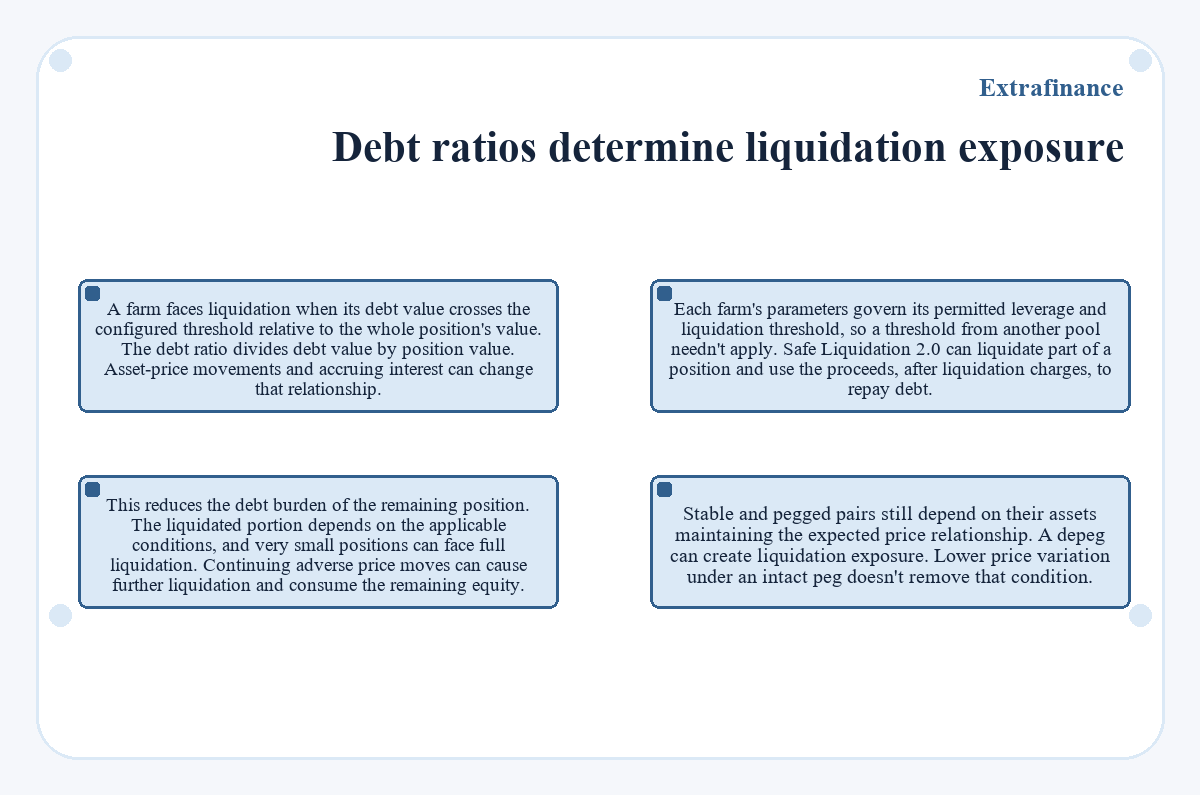
Stable and pegged pairs still depend on their assets maintaining the expected price relationship. A depeg can create liquidation exposure. Lower price variation under an intact peg doesn't remove that condition.
XLend separates collateral loans from farming debt
XLend is a separate lending product that lets supplied tokens support collateralized borrowing, distinct from the vault-only borrowing model that finances leveraged farms. Its smart-account interface also supports sub-accounts and lets users review bundled actions before submission. Its supply and borrowing rates respond to market utilization and governance parameters. A borrower monitors the health factor of the collateralized position, while repayment uses the same token that the borrower owes.
Withdrawals from XLend require sufficient unborrowed liquidity. When an account has active borrowing, a withdrawal also has to preserve adequate collateral backing. Removing collateral can weaken that position even when the market has tokens available. That account-level condition adds a constraint beyond the farm-funding pool's liquidity requirement.
Supplying assets to a farm-funding pool provides exposure to lending interest without opening personal farming debt. A leveraged farm combines pair exposure, reinvested rewards, and repayment obligations. XLend's collateral model addresses borrowing against supplied assets.
Helpful answers about Extrafinance
Do I need both tokens of a pair to open a farm?
A farming position can start with either paired asset or both paired assets. The protocol combines the contributed principal with the selected borrowing and converts the assets into the ratio needed for liquidity provision. Supplying a single paired asset doesn't remove swap costs, borrowing limits, or the farm's leverage constraints.
What is the entry minimum for a leveraged farming position?
The farming setup uses a $10-equivalent entry minimum for the principal contributed to a leveraged position. Borrowed liquidity then expands the total farming position. This entry requirement is separate from borrowing availability and the selected farm's maximum leverage, so meeting it alone doesn't establish that a farm can open.
Does the farming simulation show my final profit?
The farming simulation estimates profit and loss under the selected strategy's assumptions. It doesn't establish the eventual withdrawal value. Asset prices, borrowing interest, and swap costs affect the actual position, so an estimate and a realized outcome can differ even when the farm earns rewards.
When does a configured price-range trigger close a farm?
A configured price-range trigger directs bots to close a position when the price moves outside the range that the user set. Its trigger fee applies to the total position when that closure runs. This condition follows the chosen price range, while liquidation follows the position's debt ratio.
Is the lending and farming contract code public?
The project publishes smart-contract source code for its lending pool and farming-vault architecture. Its audit records include BlockSec and PeckShield. A deployed contract follows its own implementation and settings; public code and an earlier review don't establish that every version has identical rates, limits, or behavior.
How does a market-neutral farm differ from a long-oriented farm?
A market-neutral strategy combines offsetting long and short farming exposures to reduce directional exposure to a paired asset. A long-oriented position retains exposure to rising asset prices. Offsetting price exposure doesn't cancel borrowing costs or remove the underlying liquidity-pool and liquidation risks.
Do on-chain farming transactions require network gas?
On-chain farming transactions require network gas even when the protocol has no entrance fee. In the Optimism farming setup, ETH covers that network charge. Gas pays for executing the transaction on the chain; it's separate from borrowing interest, swap costs, and any farm-specific protocol fee.
Updated ·